Understanding Subterranean Termite Activity in Middle Tennessee Homes
Learn how Middle Tennessee's climate and soil support subterranean termite activity, what warning signs to watch for around your foundation, and how to protect your Brentwood home.
Why Middle Tennessee Is Prime Real Estate for Subterranean Termites
Middle Tennessee features a humid subtropical climate characterized by generous annual rainfall, long and warm summers, and relatively mild winters. While these conditions create the lush, green landscapes that make communities like Brentwood so desirable, they also establish an ideal habitat for subterranean termites. Specifically, the eastern subterranean termite (Reticulitermes flavipes) is the most widespread and structurally destructive termite species found throughout this region.
Unlike drywood termites, which live entirely inside the wood they consume, subterranean termites require continuous contact with soil or a reliable moisture source to survive. Middle Tennessee’s dense clay-heavy soils hold moisture long after rainstorms, creating an underground environment where termite colonies can thrive undisturbed. These colonies often reside deep beneath the frost line, moving upward as soil temperatures warm in the spring to forage for cellulose, the organic compound that forms the structural framework of wood.
How Subterranean Termites Operate
Subterranean termites are social insects organized into a strict caste system: workers, soldiers, and reproductives. Understanding the role of each caste helps homeowners understand how infestations develop and why they often remain hidden for months or even years.
- Workers: Making up the vast majority of the colony, sterile, blind worker termites perform all the actual destruction. They forage continuously, chewing through structural framing, subflooring, and paper-faced drywall to harvest cellulose, which they then digest and share with the rest of the colony.
- Soldiers: Recognizable by their elongated heads and prominent mandibles, soldiers defend foraging tunnels and the central nest against predatory ants and other threats.
- Reproductives (Swarmers): Also known as alates, winged reproductive termites leave mature colonies on warm, humid spring days—frequently following a soaking rain. Their sole purpose is to pair off, shed their wings, burrow into the soil, and establish new colonies.
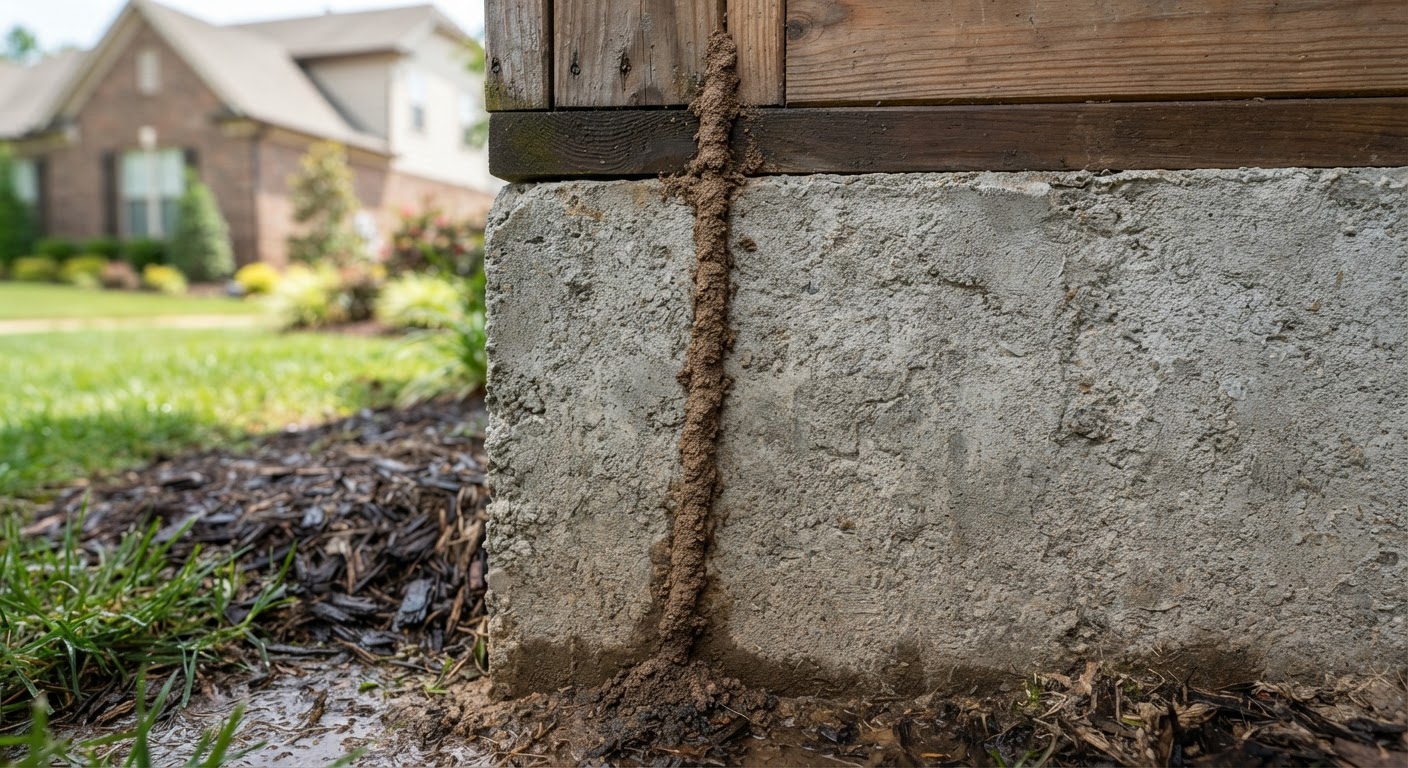
Because worker termites have delicate, thin exoskeletons that rapidly lose moisture when exposed to open air, they cannot travel unprotected across exposed foundations. To navigate open surfaces, they construct shelter tubes—commonly called mud tubes—made of soil particles, chewed wood fibers, and saliva. These tubes maintain the humidity levels the workers need to survive while traveling between their subterranean nest and the structural framing of a house.
Recognizing the Signs of an Active Infestation
Because subterranean termites feed on the interior of wood members, leaving the outer surface or paint intact, structural damage often goes unnoticed until it has progressed significantly. Brentwood homeowners should remain vigilant for several key indicators of termite activity:
Mud Shelter Tubes
Mud tubes are among the most definitive signs of subterranean termite activity. These pencil-thick earthen tunnels usually run vertically across poured concrete foundations, cinder blocks, brick piers, or interior crawl space walls. They allow termites to transition from the damp soil to wooden sill plates and floor joists. Breaking open a section of a mud tube may reveal small, creamy-white worker termites moving inside; however, even an abandoned mud tube confirms that termites have previously explored that pathway.
Spring Swarmers and Discarded Wings
In Middle Tennessee, subterranean termite swarms typically occur between late March and early June, often during the late morning following a spring rain shower. Homeowners might see dozens of small, dark-bodied insects fluttering near windows, light fixtures, or foundation walls. Even if you miss the swarm itself, finding piles of shed, translucent wings of uniform size on windowsills, baseboards, or spiderwebs is a strong indication that a colony is nearby or inside the structure.
Wood That Sounds Hollow or Gives Way
Subterranean termites excavate tunnels along the softer springwood grain, leaving the harder summerwood rings behind. When tapped with the handle of a screwdriver, infested wood often produces a hollow, dull sound. In advanced situations, floorboards may feel spongy underfoot, door frames may sag, or drywall paper may exhibit subtle blistering that resembles moisture damage.
Frass and Pinholes in Drywall
While subterranean termites do not push out neat piles of granular droppings like drywood termites, they sometimes chew tiny pinholes through drywall paper while foraging for cellulose backing. Homeowners may spot minute, soil-colored spots where termites have plugged these exit holes with a mixture of dirt and secretions to preserve interior humidity.
Unique Vulnerabilities in Brentwood Residential Construction
The architectural styles and foundation types common throughout Brentwood present specific entry points that subterranean termites exploit. Recognizing these structural vulnerabilities is an important part of proactive property care.
Crawl Space Foundations
Many homes in the area are built over crawl spaces. Unencapsulated crawl spaces with bare dirt floors create a microclimate with elevated relative humidity and damp framing members. If ground moisture vapor rises unchecked, sill plates, girders, and joists absorb water, softening the timber and making it vastly more attractive and accessible to foraging subterranean termites.
Slab Expansion Joints and Plumbing Penetrations
Homes built on concrete slabs are not immune to subterranean termite infestations. Concrete slabs routinely develop hairline shrinkage cracks, and plumbing lines penetrate the slab to supply kitchens, bathrooms, and laundry rooms. Termites require a gap of only 1/32 of an inch—the thickness of a standard business card—to bypass concrete barriers and reach baseboards or wall studs.
Brick Veneer Weep Holes
Brick veneer exteriors require weep holes along the bottom course of bricks to allow trapped moisture to escape the wall cavity. However, if exterior soil, landscape mulch, or garden beds are piled too high against the foundation, these weep holes can end up at or below ground level. This provides subterranean termites with direct, sheltered access into wall cavities without requiring visible mud tubes on the foundation face.
Practical Measures to Reduce Termite Attraction
While professional treatments are essential for eliminating existing colonies, homeowners can take meaningful environmental steps to make their properties less welcoming to subterranean termites:
- Divert Foundation Moisture: Ensure roof gutters and downspouts are clear and discharge water at least five to ten feet away from foundation walls. Grade the landscape so that rainwater drains away from the structure rather than pooling around the perimeter.
- Eliminate Direct Wood-to-Soil Contact: Trellises, wooden fence posts, deck stair stringers, and siding should never contact bare earth. Maintain a visible inspection gap of at least six inches between exterior soil and the bottom edge of your siding or stucco.
- Manage Mulch and Ground Cover: Organic mulches retain moisture and provide cover for foraging pests. Avoid piling wood mulch directly against foundation walls; maintain an unmulched buffer zone or consider non-cellulose alternatives near the house.
- Store Firewood Remotely: Keep firewood piles, scrap lumber, and cardboard boxes elevated on metal racks and positioned well away from exterior walls.
- Maintain Crawl Space Dryness: Install high-grade vapor barriers across exposed dirt in crawl spaces, repair plumbing leaks promptly, and consider crawl space dehumidification to keep wood moisture levels low.
Professional Inspection and Colony Elimination
Because subterranean termite colonies can contain hundreds of thousands of individuals living deep underground, over-the-counter spray treatments or spot applications rarely resolve an infestation. Surface sprays simply kill the worker termites in the immediate area, prompting the rest of the colony to seal off that tunnel and forage in a different direction within your home.
Comprehensive termite management relies on methodical structural inspections to identify all active foraging channels and entry points. Depending on the home's construction, effective remediation may involve non-repellent liquid soil barriers that foraging workers carry back into the nest, or advanced subterranean baiting systems strategically installed around the perimeter. Both strategies target the colony as a whole, eliminating the reproductive queen and halting structural destruction.
Protect Your Middle Tennessee Home
Subterranean termites work silently, but structural damage does not have to be an inevitable part of living in Middle Tennessee. If you have spotted mud tubes, discovered discarded swarmer wings, or want the peace of mind that comes with a thorough crawl space and foundation evaluation, contact Granite Finch Pest Control today to schedule a detailed residential termite inspection for your Brentwood home.
Need help from Granite Finch Pest Control?
Contact our team to discuss your service needs in Brentwood and surrounding service areas.